


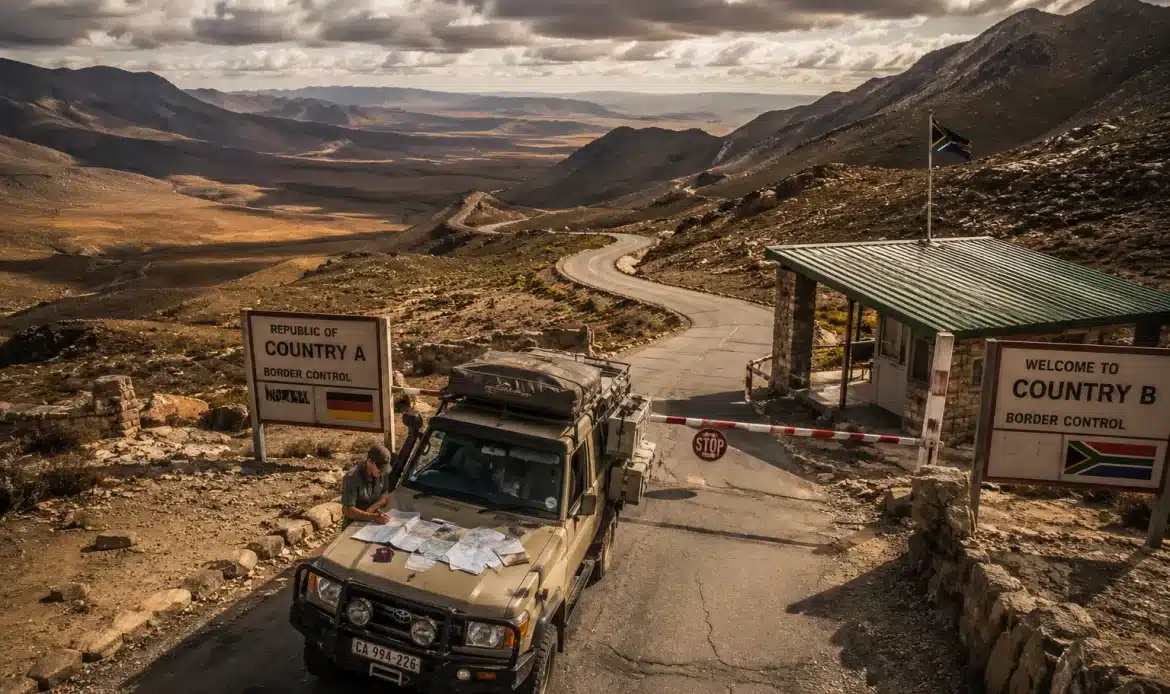
Why great expeditions are built on preparation, partnerships and trusted local knowledge.
Few travel experiences compare to crossing international borders under your own wheels.
From mountain passes in Central Asia to the vast landscapes of Patagonia, multi-country overland expeditions offer an unrivalled sense of freedom and discovery.
Yet behind every successful expedition lies months of planning, coordination and problem-solving.
For professional expedition operators, the greatest challenges often begin long before the journey starts.
Every Border Is Different
Unlike traditional tourism, overland expeditions rarely operate within a single country.
Every border introduces new regulations, customs procedures, insurance requirements and operational considerations.
Documentation that is perfectly valid in one country may need additional permits in another. Seasonal restrictions, temporary closures and changing regulations can all affect carefully planned itineraries.
Successful expedition planning requires flexibility as much as preparation.
Vehicle Availability
One of the industry’s biggest operational challenges is accessing suitable expedition vehicles in multiple regions.
Many operators either invest heavily in maintaining fleets across different countries or rely on finding trusted local suppliers through personal contacts.
Both approaches present challenges.
Owning fleets in multiple regions requires significant capital investment, ongoing maintenance and local administration.
Finding new suppliers often involves uncertainty regarding vehicle standards, reliability and operational support.
Neither solution scales easily.
Local Knowledge Matters
Maps can show roads.
Local partners explain how those roads behave.
Weather conditions, seasonal river crossings, road construction, fuel availability and local regulations can all change rapidly.
An experienced regional partner understands these realities because they operate there every day.
That local knowledge often becomes the difference between a smooth expedition and unnecessary delays.
Standards Build Confidence
Consistency is one of the least visible—but most valuable—parts of expedition planning.
When vehicles are prepared to recognised standards, maintenance procedures are documented and equipment is consistently fitted, operators can focus on delivering exceptional customer experiences rather than worrying about operational uncertainty.
Professional standards create confidence.
Confidence builds trust.
Trust allows networks to grow.
A New Way Forward
The overland industry is evolving.
Rather than expanding through larger vehicle fleets alone, many operators are beginning to recognise the value of trusted regional partnerships.
A connected network allows expedition companies to access reliable local infrastructure while maintaining consistent operational quality across multiple destinations.
Instead of building everything themselves, operators gain access to carefully selected regional expertise already established on the ground.
The Future of Expedition Planning
The future of overland travel will not simply be measured by the number of vehicles available.
It will be defined by how effectively those vehicles, operators and regional partners work together.
Shared standards.
Trusted relationships.
Reliable local knowledge.
These are the foundations of truly global expedition operations.
That is the vision driving the GOBI Network.
A connected infrastructure that enables expedition operators to plan further, expand confidently and deliver remarkable journeys through certified regional partners around the world.
Because every unforgettable expedition deserves an equally dependable foundation.
About GOBI
GOBI is building the infrastructure behind global overland expeditions—connecting professional expedition operators with certified regional vehicle hubs through shared standards, trusted partnerships and a growing international network.