


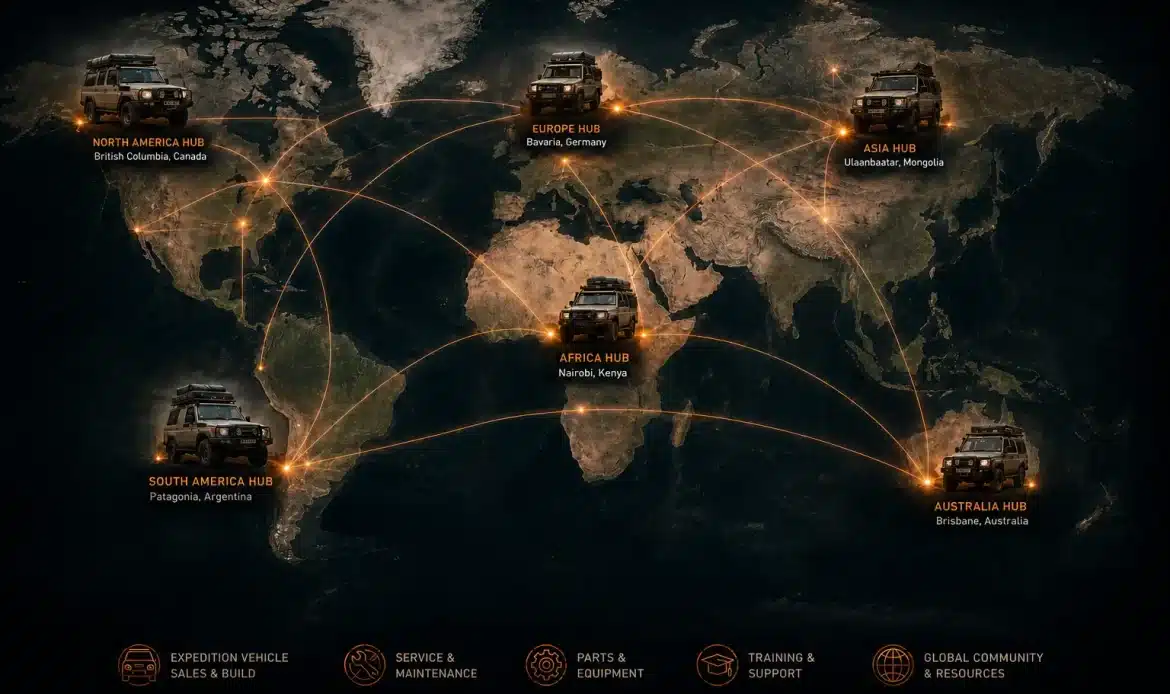
The next evolution of expedition travel isn’t about owning more vehicles. It’s about connecting the right ones.
For decades, growth in the overland expedition industry followed a simple formula.
More destinations required more vehicles.
More vehicles required more investment.
More investment created more complexity.
It was a model that worked—but only to a point.
Today, the industry is changing.
Not because people want fewer adventures.
But because the world has become far more connected.
Every Mature Industry Eventually Builds Networks
History tells an interesting story.
Airlines don’t build airports.
Shipping companies don’t own every port.
Hotels rarely own every building carrying their brand.
Cloud providers don’t build every data centre they use.
Modern industries grow by creating trusted networks rather than owning every asset themselves.
Overland expeditions are beginning to reach that same point.
The Real Asset Isn’t the Vehicle
A well-prepared expedition vehicle is important.
But a vehicle sitting in the wrong country has little value to an operator working thousands of kilometres away.
The real asset is access.
Access to reliable vehicles.
Access to experienced regional partners.
Access to trusted local knowledge.
Access to operational support when plans inevitably change.
That access is far more valuable than ownership alone.
Regional Expertise Cannot Be Replaced
No digital platform can replace decades of local experience.
Every region has its own terrain.
Its own climate.
Its own regulations.
Its own culture.
The people who understand these environments best are the local operators who work there every day.
The future of expedition travel is not about replacing them.
It is about connecting them.
Collaboration Creates Scale
Traditionally, expanding into new regions required significant investment.
Operators often faced difficult choices.
Purchase additional vehicles.
Establish local operations.
Or decline opportunities altogether.
A connected network changes that equation.
Instead of replicating infrastructure, operators gain access to existing regional expertise while local hubs gain international visibility.
Everyone grows together.
That is a far more sustainable model.
Standards Build Trust
Networks only succeed when everyone shares confidence in the people they work with.
That confidence comes from common standards.
Consistent vehicle preparation.
Clear operational procedures.
Professional maintenance.
Transparent agreements.
Reliable communication.
Standards transform individual businesses into a professional network.
Building the Infrastructure Behind Expeditions
GOBI was created around a simple observation.
The overland industry already possesses exceptional regional expertise.
What it lacks is a shared infrastructure that allows operators and hubs to work together efficiently across international borders.
Rather than replacing local businesses, GOBI strengthens them.
Rather than competing with expedition operators, GOBI supports them.
Rather than owning fleets, GOBI connects them.
The objective is not to build the world’s largest expedition company.
The objective is to build the world’s most trusted expedition infrastructure.
Looking Ahead
The next decade of overland travel will not be defined by who owns the most vehicles.
It will be defined by who builds the strongest relationships.
Professional operators.
Certified regional hubs.
Shared standards.
Connected infrastructure.
Together, these create something far greater than individual fleets.
They create a global expedition network.
That is the future GOBI is building.
One trusted partnership at a time.
About GOBI
GOBI is building the infrastructure behind global overland expeditions—connecting certified regional vehicle hubs with professional expedition operators through shared standards, trusted partnerships and a growing international network.